Equitable Building
Electrification Action Plan
Reducing carbon pollution from our homes, businesses, and public buildings.


 Local jurisdictions across Sonoma County are working together to reduce the carbon emissions that drive climate change. This “carbon pollution” comes from many different sources with over 23% related to the energy we use within our buildings for heating, cooling, cooking, and other purposes. The formation of Sonoma Clean Power in 2014 and their focus on lower-carbon electricity has helped reduce these emissions from building energy use over 45 percent from 1990 to 2022.
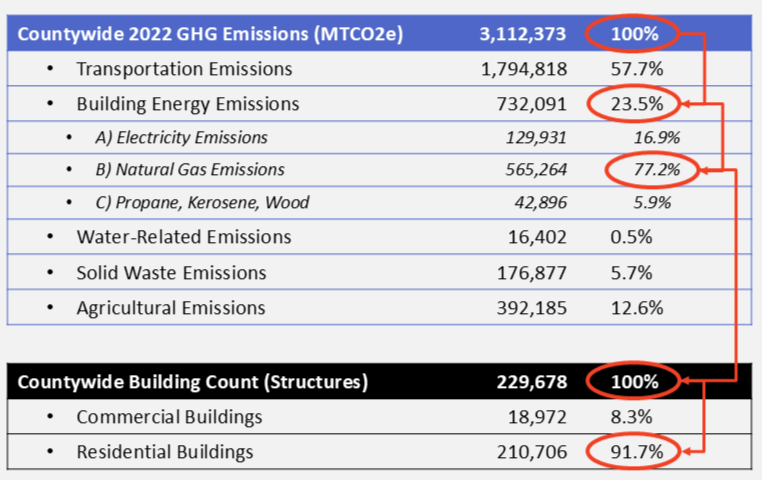 Unfortunately, emissions from methane gas use have only reduced a small amount over this same time and have become a more significant percentage of total emissions. To continue reducing our impact, mechanical systems and household appliances that rely on methane gas will need to be upgraded over the upcoming years to be as efficient as possible and to produce zero emissions.
| Equitable Building Electrification Resources |
|---|
With this end in mind, SCTCA has recently developed an Equitable Building Electrification Action Plan to guide local electrification and decarbonization efforts to meet Sonoma County’s carbon neutrality goal. To reduce methane gas use within buildings – and subsequently lower emissions – two efforts need to take place: 1) increased energy efficiency improvements and 2) additional decarbonization upgrades. While these two phases can be accomplished in either order, we will discuss efficiency first.
The ideal first step is to evaluate building energy use and implement measures to improve building energy efficiency, such as air sealing, attic and wall insulation, duct repair, high-efficiency windows and doors, and reflective roofs to reduce overall energy use. After improving energy efficiency, the next step is to transition from fossil fuels to clean electricity by upgrading methane gas furnaces, hot water heaters, kitchen stoves and ovens, and pool or spa heaters.
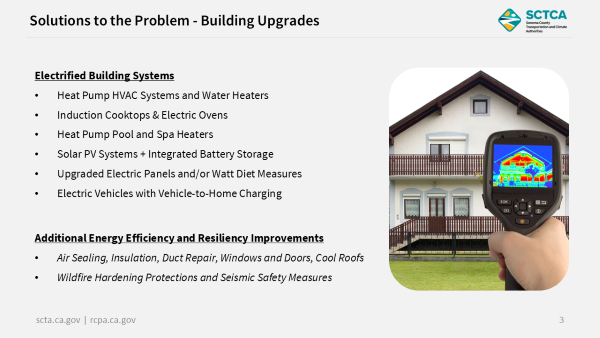
In some cases, electric panels may not have sufficient capacity to allow for increased use of electricity and must also be upgraded, although installing “Watt Diet” measures or choosing more efficient appliances can help manage electric load so that panel upgrades are not required.
Additionally, a number of potential upgrades may not directly reduce emissions but would allow for increased resiliency during electric outages or natural disasters. Some of these resilience upgrades include installing wildfire hardening and seismic safety resiliency measures, adding solar photovoltaic systems with integrated battery storage, and purchasing electric vehicles with bi-directional charging as an additional backup option.
Taken together, the complete list above will be very expensive for the average homeowner – and often completely unattainable for low-income households. There will be an ongoing need to provide rebates and incentives, offer technical assistance and turnkey installation programs, and develop innovative financing options to make this an attainable reality for many building owners across Sonoma County.
Another major aspect of the scale of work needed is the sheer number of structures throughout the county that may need upgrades. There are just under 230,000 structures across Sonoma County, with single family and multifamily residential properties making up over 90% of these buildings. When analyzed by square footage, residential buildings account for 67.5% of the total building footprint, with commercial buildings covering 32.5%. Given these relative proportions, the scale of the residential effort will be much larger than that needed for commercial building upgrades and SCTCA’s initial efforts will be focused here first.
Throughout the development of this Action Plan, a consistent effort has been made to solicit and include feedback from a wide range of stakeholders. Not surprisingly, many concerns we identified are related to increasing long-term utility rates, the up-front costs for building upgrades, and the long-term affordability of operating and maintaining the new equipment. On the positive side, we also received a number of suggestions on how to link this work to other community-wide efforts, such as partnering with community health centers that are looking to become resilience hubs, developing community-based turnkey installation services, and leveraging the work of the Bay Area Air District as a vehicle for outreach and workforce education throughput the county.
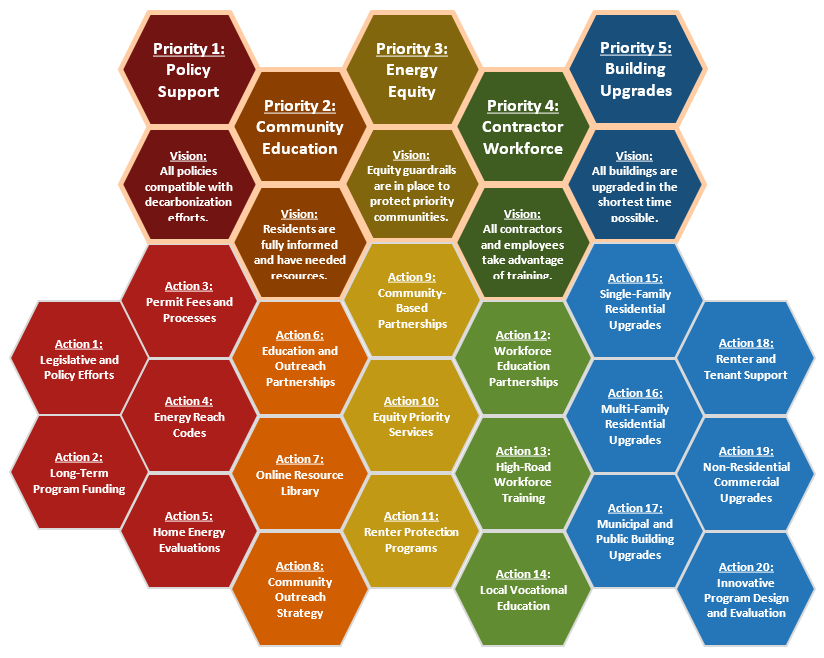
Based on a review of local climate action plans, an analysis of Sonoma County’s building stock, and input from local jurisdiction staff and community stakeholders, SCTCA has identified five Priority Areas for action and has developed a long-term Strategic Vision statement for each of the areas.
Additionally, recommended actions were identified for each area that provide additional details on specific actions that are proposed to electrify the countywide building stock. Given current staffing and resources available, SCTCA can take the lead on only a handful of these items and additional long-term funding will need to be identified before all actions can be fully implemented. SCTCA will have the most impact by focusing first on our current strengths of policy, funding, and partnerships.
| Priority Areas | Strategic Vision |
|---|---|
| 1: Policy Support | All local, regional, and state policies either directly support or are compatible with building decarbonization and electrification efforts. |
| 2: Community Education | Local residents are fully informed about the financial and environmental benefits of building electrification and have access to the resources needed. |
| 3: Energy Equity | Equity guardrails are in place to protect Sonoma County’s equity priority and low-income communities from unexpected cost increases or displacement. |
| 4: Contractor Workforce | All local building contractors, their current employees, and future recruits have access to and take advantage of workforce development training. |
| 5: Building Upgrades | All existing buildings are upgraded to reduce emissions, increase energy efficiency, and become more resilient in the shortest time possible. |
SCTCA’s initial focus will be on supporting local government policy efforts that encourage electrification and on developing funding resources for expanded implementation through collaborative multi-jurisdictional grant applications. Specific grants have not yet been determined, but this work to identify shared projects and potential funding options will be accomplished through a series of Climate Grant Planning and Coordination Meetings.
| 1: Policy Support | Recommended Actions |
|---|---|
| *Action 1: Legislative and Policy Efforts | Provide support for the adoption and implementation of legislative and policy efforts by local, regional, and statewide agencies that encourage building decarbonization and electrification efforts, with an initial focus on preparing for the implementation of the Bay Area Air District’s Building Appliance Rules for water heaters and furnaces. |
| *Action 2: Long-Term Program Funding | Coordinate efforts among local jurisdictions and other countywide agencies to develop stable long-term funding for expanded building electrification efforts countywide using equity-based approaches. |
| Action 3: Permit Fees and Processes | Work in partnership with local jurisdictions, existing countywide roundtables, and regional resource providers to evaluate potential permitting changes to further support and simplify the installation of zero-emission equipment in existing buildings. |
| Action 4: Energy Reach Codes | Evaluate adoption of “energy performance” reach codes for new construction and “air conditioning to heat pump” model ordinances for existing buildings that are allowable under the newly adopted restrictions to building code standard amendments. |
| Action 5: Home Energy Evaluations | Develop a model ordinance for jurisdictions that requires owners of existing buildings to conduct a Home Energy Score evaluation prior to listing the building for sale and to provide a summary of the most recent evaluation to prospective lessees and buyers. |
*Initial SCTCA Focus: Action 1 and Action 2
SCTCA’s initial focus will be on developing local partnerships to coordinate outreach, integrate program offerings, and share educational materials to make the process of upgrading building systems and identifying rebates less time-consuming and confusing.
| 2: Community Education | Recommended Actions |
|---|---|
| *Action 6: Education and Outreach Partnerships | Create a partnership among local jurisdictions, electric power providers, and other agencies working on decarbonization efforts to identify priority outreach efforts, strategize on program collaboration and integration, and share education and outreach materials. |
| Action 7: Online Resource Library | Compile and promote an online library of educational materials on decarbonization building upgrades, electrical panel optimization, local building contractors, available incentives and financing, and other co-benefits such as energy cost savings, improved indoor air quality, and household comfort. |
| Action 8: Community Outreach Strategy | Develop strategies for expanded outreach to owners of existing buildings, renters and tenants, the contractor workforce, and local community-based organizations, especially those in equity priority areas to better communicate the process of building electrification, the financial and technical assistance available, and the benefits of decarbonization upgrades. |
*Initial SCTCA Focus: Action 6
SCTCA’s initial focus will be on developing community-based partnerships to provide additional support for outreach efforts and technical assistance within equity priority areas.
Recommended Actions
| 3: Energy Equity | Recommended Actions |
|---|---|
| *Action 9: Community-Based Partnerships | Partner with local community-based organizations to provide culturally-inclusive educational resources and translated materials to support outreach and engagement on electrification upgrades, including available incentives and financing, technical assistance, potential energy bill impacts, and renter displacement protections. |
| Action 10: Equity Priority Services | Partner with Sonoma Clean Power, BayREN, Healdsburg Electric, and other incentive providers to ensure that accessible funding and financing options, technical assistance, and multi-language services are available for households in equity priority and low-income communities. |
| Action 11: Renter Protection Programs | Leverage and expand any existing renter protection programs and/or anti-displacement ordinances to ensure households are not displaced or negatively impacted by higher rents following building upgrades, giving special attention to untracked housing cost increases due to utility cost shifts, to the potential loss of naturally occurring affordable housing, and to concerns that landlords may choose to not participate in upgrade programs due to concerns of reduced eviction powers. |
*Initial SCTCA Focus: Action 9
SCTCA’s initial focus will be to identify the appropriate lead(s) to better support local building contractors and expand workforce training options. This work will also include building the “business case” for contractor investments in decarbonization training.
| 4: Contractor Workforce | Recommended Actions |
|---|---|
| *Action 12: Workforce Education Partnerships | Partner with Sonoma County Economic Development Collaborative, Career Technical Education Foundation, North Coast Builders Exchange, and other workforce-related efforts to analyze the barriers faced by the local decarbonization workforce, identify potential solutions, implement high-priority actions to support local building contractors, and document the “business case” focusing on building electrification. |
| Action 13: High-Road Workforce Training | Expand “high road” workforce training opportunities on zero-emission technologies and decarbonization installation techniques for building contractors and their current employees. |
| Action 14: Local Vocational Education | Support efforts by local educational institutions to expand inclusive decarbonization training opportunities for prospective future workers who are current students preparing to enter the building workforce. |
*Initial SCTCA Focus: Identify appropriate lead agencies for this partnership,
but focus our direct efforts on other identified recommended actions.
SCTCA’s initial focus will be on promoting existing resources, as well as to identify and evaluate innovative approaches that require additional funding resources prior to implementation. Multiple existing upgrade programs are available for local building owners, but rebates alone are not enough to remove the multitude of barriers facing residents.
| 5: Building Upgrades | Recommended Actions |
|---|---|
| +Action 15: Single-Family Residential Upgrades | Provide increasing support to owners of single-family residential homes, especially through the promotion of BayREN’s Efficiency and Sustainable Energy (EASE) Home Program and other municipal energy provider, state, or local incentive programs or assistance services. |
| +Action 16: Multi-Family Residential Upgrades | Provide increasing support to owners of multi-family residential buildings, especially through the promotion of BayREN’s Bay Area Multifamily Building Enhancements (BAMBE) Program and other municipal energy provider, state, or local incentive programs or assistance services. |
| +Action 17: Municipal and Public Building Upgrades | Create a partnership among local jurisdictions to most-efficiently access technical assistance and financial incentives (such as BayREN’s Integrated Energy Services and Targeted Decarbonization Services programs and other municipal energy provider, state, or local incentive programs or assistance services) with the goal of upgrading all public buildings to zero-emission alternatives and installing additional energy efficiency and resilience upgrades, including an evaluation of fossil-fuel backup emergency generators and potential alternatives. |
| Action 18: Renter and Tenant Support | Provide increasing support to renters and tenants who support energy efficiency and resilience upgrades but need assistance in making basic in-place improvements and/or working with their landlord to authorize the decarbonization improvements. |
| +Action 19: Non-Residential Commercial Upgrades | Provide increasing support to owners of non-residential commercial buildings, especially through the promotion of BayREN’s Business Program for small and medium businesses and other municipal energy provider, state, or local incentive programs or assistance services. |
| *Action 20: Innovative Program Design and Evaluation | Identify and evaluate innovative approaches to expanded building electrification that require additional funding resources prior to implementation, including such proposals as completing a countywide building stock and energy use analysis, creating a building benchmarking and building performance standards program for existing buildings, expanding energy concierge and project management services for property owners, developing a turnkey installation programs for single-family residential and a direct install programs for low income households, offering additional support for low-income households and equity priority communities, and creating an emergency appliance loaner program to facilitate the installation of zero-emission replacements. |
+Current building upgrade program funding is available,
but additional resources are needed for increased activities.
*Initial SCTCA Focus: Action 20
Several additional themes have been identified that will also guide implementation of the Action Plan:
Each of the audiences listed above will be integral to our long-term efforts to decarbonize our building stock and become carbon neutral in the shortest time possible. This Action Plan may help to define the actions that are needed, but our long-term success will be based on a multi-stakeholder, multi-objective approach built around strategic partnerships, long-term affordability, and social equity.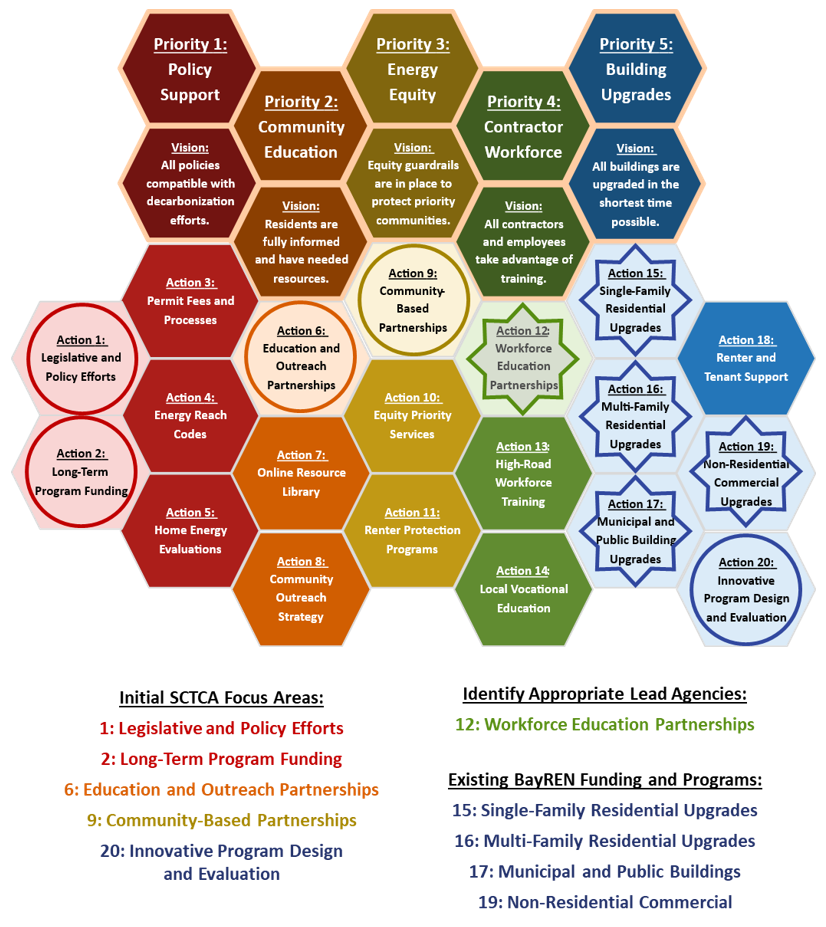
You can read the full Countywide Equitable Building Electrification Action Plan at the following link:
https://rcpa.ca.gov/wp-content/uploads/2025/09/SCTCA-EBEAP-FINAL-APPROVED-2025-09-08.pdf


